‘Trust will be the most valuable currency’: Q&A with The Quint
Editor Abhilash Mallick shares how his organization creates deeply researched reporting while contending with systems that reward output over all else.

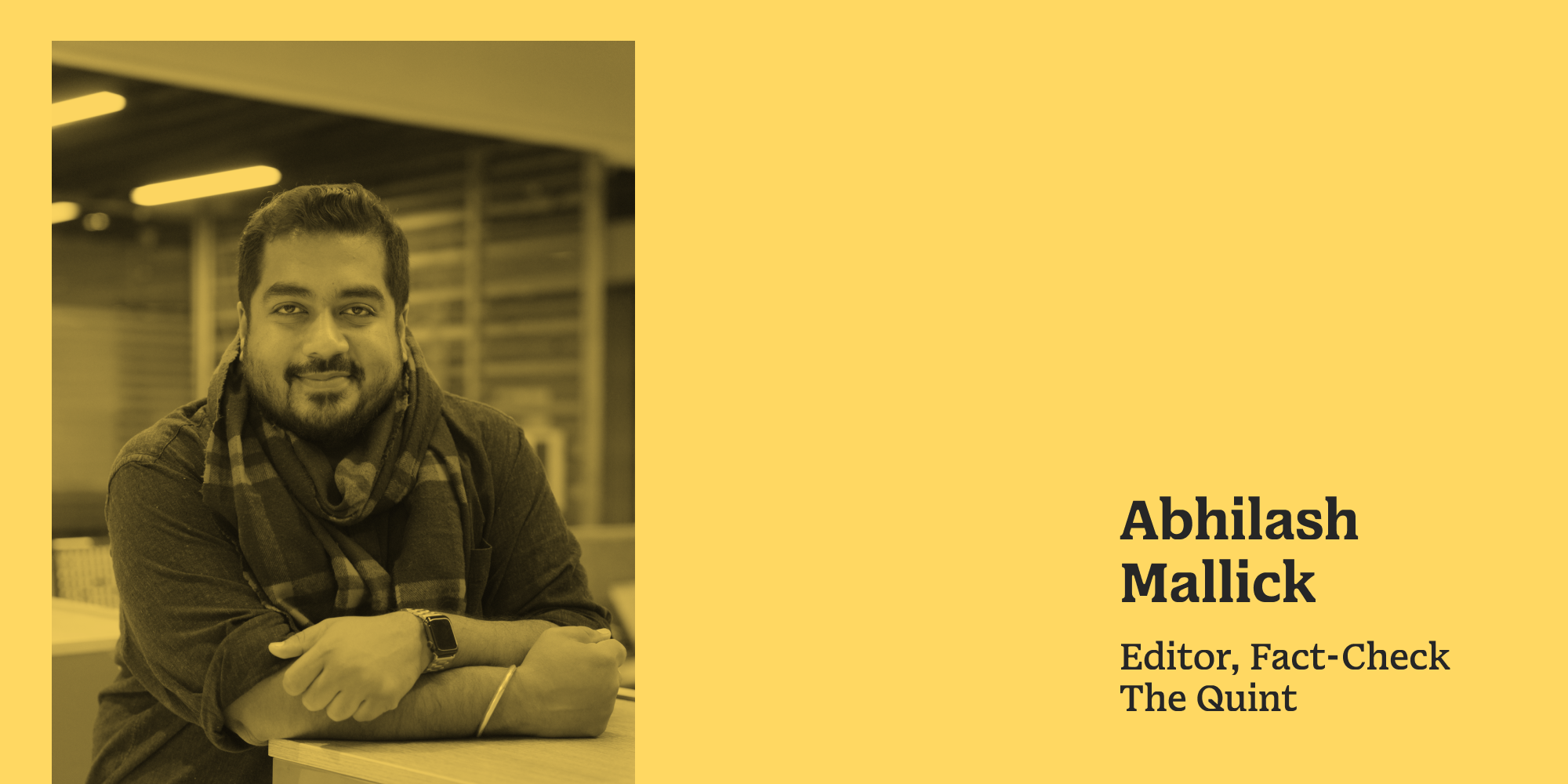
Editor Abhilash Mallick shares how his organization creates deeply researched reporting while contending with systems that reward output over all else.
We caught up with our friends at The Quint, an India-based English and Hindi news organization and long-time Meedan partner.
This interview has been lightly edited for length and structure.
At The Quint, our motto is, “Question everything.” After a successful 10-year run of being a pure-play digital publication, we have embarked on a significant transformation of our content model. We have pivoted away from breaking news and “commodity news” to further increase our focus on enterprise journalism, ground reporting, fact-checking, and a membership-based revenue model.
We conduct deep dives into the most pressing questions India is grappling with, especially in the field of communalism, India’s job crisis, climate change, and fact-checks, among a host of other compelling, credible, and community-driven projects.
It feels defiant. We believe that speed, volume, and virality often come at the cost of accuracy or nuance. At The Quint, slowing down was a conscious editorial choice. Firstly, a small team of journalists could never compete with the legacy media organizations. Secondly, in order to succeed with a membership-based model, we needed to stand out and deliver stories that were unique to us. While this sometimes means losing the race to be first, we believe it strengthens our credibility over time. It is also reassuring to know that our work is built to last beyond a single news cycle.
Fragmentation has fundamentally reshaped how audiences encounter news. More than once in our years of coverage, we have adapted to the changing online landscape — from publishing heavily on Twitter (now X) and Facebook to trying our hands at TikTok and Instagram Reels. A single piece of our reporting can exist as a long article, a short video, a visual explainer, and a regional-language adaptation. At the same time, we focus heavily on framing and clarity, ensuring that even a 30-second video carries context and avoids oversimplification.
We have tried to keep up with the trends, but have ensured that our core offering is not diluted. The underlying reporting remains consistent; what changes is the format and entry point.
With publishers and audiences moving towards using AI more, we have begun experimenting with the technology and are trying our best to innovate and stay relevant.
As we’ve published fewer stories, we’ve seen a significant drop in traffic due to a combination of factors, including changes in search — especially Google’s AI overviews — and changes in Meta’s approach towards news. Reduced visibility also translates into fewer memberships. Traffic spikes are harder to anticipate these days, referral patterns fluctuate, and traditional strategies for search engine optimization no longer guarantee visibility for our content.
Reduced visibility and competition from large legacy media organizations pushed us to rethink how we position ourselves. We knew that publishing less would mean less reach and engagement, and that’s when we started to reassess what “reach” means.
Publishing fewer stories also resulted in the downsizing of existing teams while hiring people who have specialized expertise. Now we let our reporters sit with a story idea for longer so they can get to the best and most nuanced version of their idea. Instead of optimizing solely for platforms, we are investing more in brand trust, loyal audiences, and recognizability.
Given that this is still an ongoing experiment, we have yet to decide if it has paid off.
We began discussing the possibility in 2023 and tried out using AI for image generation in video stories, headline suggestions, and to generate meta tags. But the major catalyst was a program run by the World Association of News Publishers (WAN-IFRA) in 2024 to introduce newsrooms to new use cases for AI. Given that we were working with a small team and limited resources, our use of AI came from a very practical place — scale and efficiency.
We began by using the automatic translation feature built into our content management system. We then started experimenting with our personalization feature, NewsEasy, which is in its second season right now, and it’s become more interactive. We have also experimented with platforms for automating email responses, newsletters, and news curation.
Every output is still edited by humans and led by journalists. The goal is not automation for the sake of it, but thoughtful integration that strengthens accuracy, reduces burnout, and allows smaller teams to do impactful work at scale.
NewsEasy is The Quint’s first AI-powered product designed to improve and personalize how audiences consume news on our platform. It operates under strict editorial oversight to help readers quickly understand why a story matters.
The product embeds multiple AI-supported features within articles, including contextual summaries (“In Short”), key takeaways (“The Big Points”), question-led explainers (“Questions & Answers”), and audio narration. The idea is to reduce friction in news consumption while encouraging deeper engagement for people who don’t have the time to fully explore long-form content.
Most critical forms of editorial labor are largely invisible to algorithms. Many good stories take weeks to shape, but because commercial recommendation algorithms prefer breaking stories over deeply researched ones, these articles end up getting only a few thousand views. Algorithms tend to reward output, not restraint.
Even fact-checking takes hours. You have to trace sources, check documents, consult experts, and decide what not to publish, which rarely translates into engagement metrics. This creates a structural imbalance where responsible journalism is often less visible than sensational or misleading content.
We believe that the time spent investigating stories, producing videos, and adapting work to different storytelling formats is mostly ignored by algorithms.
As I mentioned earlier, The Quint is planning on increasing its subscription base. With that in mind, we believe that Suwali can complement what we have already built with NewsEasy. We can offer NewsEasy and Suwali together as part of a subscription and get more people to use AI to engage with our stories actively. Given that Suwali will only source answers using The Quint’s content, we are confident it will not hallucinate and will be engaging for our readers.
Our experiments with NewsEasy have so far been successful in generating more engagement, which means there is an appetite among our audiences for AI-generated personalization features.
Five years from now, journalism is likely to be leaner, more specialized, and more trust-centric. Large-scale, general-interest newsrooms may shrink, while niche, expertise-driven outlets grow. AI will be embedded in workflows, but credibility will be driven by humans.
In India, as people seek news that reflects their lived realities rather than generic national narratives, linguistic diversity and regionalization will be key to reaching new, loyal audience bases. Revenue models will continue to evolve, but trust will be the most valuable currency.
We urge everybody to value news over virality and to remain curious, skeptical, and patient. Supporting credible journalism — by reading, sharing responsibly, or subscribing — is not just a personal choice but a civic one.
Also, questioning information doesn’t mean distrusting everything; it means seeking context and evidence.
Want to stay up to date with Meedan and its partners? Sign up for the Checklist newsletter today.