Fighting ‘algorithmic exclusion’ and online harm in Brazil
In Brazil, a new initiative powered by Suwali is helping women journalists protect themselves in the face of harassment and other digital threats.

In Brazil, a new initiative powered by Suwali is helping women journalists protect themselves in the face of harassment and other digital threats.
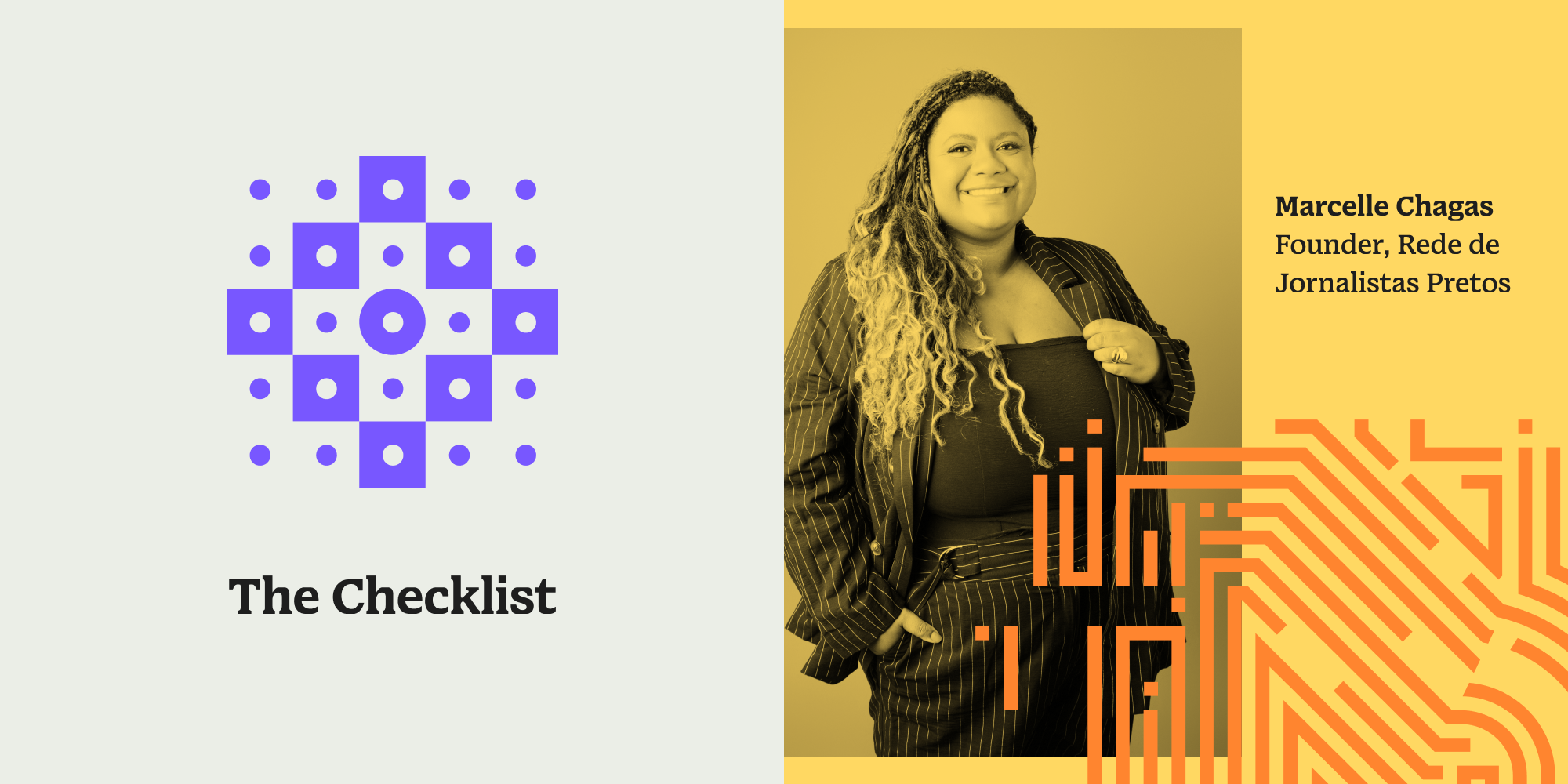
Marcelle Chagas is no stranger to online harassment. An acclaimed media innovator and current Mozilla Tech & Society Fellow, Chagas leads Rede de Jornalistas Pretos (Black Journalists Network), an organization that supports Black journalists and communicators through capacity-building programs, research, policy advocacy, and technological innovation. Among the many challenges that the network faces, racism and gender-based violence online are paramount.
Last year, as part of an international study on sustainability in independent journalism, Rede JP identified a prominent theme: Media workers often need immediate guidance when facing online harassment, disinformation campaigns, and other digital threats. Without this, their ability to work falters.
Marcelle’s team had ample information resources for people facing these problems — but they knew that a tech-based solution could help ensure they reached the people who need them most. Soon, she connected with Meedan. Given our extensive experience studying online harm, a partnership unfolded easily from there.
This month, we’re proud to announce that we’re working with Marcelle and Rede de Jornalistas Pretos to launch Latinas IA, an innovative solution for journalists facing digital threats. Built on Meedan’s Suwali platform, Latinas IA offers trustworthy, immediate guidance to media workers across Latin America facing digital threats. It launched earlier this month, as part of a series of events and workshops marking the International Day of Afro-Latin American Women.
In a recent interview with our team, Marcelle explained the importance of responding rapidly to the needs of journalists under threat. “Human support remains essential,” she said, “but by itself it cannot respond at the speed and scale these situations demand.”
Marcelle explained how Suwali is enabling her organization to scale this work. “Powered by Suwali’s technology, [Latinas IA] transforms years of practical knowledge into an accessible tool that provides reliable guidance whenever communicators need it. For us, technology does not replace people. It expands our ability to protect them and democratizes access to trusted knowledge.”
Read the full interview with Amaralina Xavier, Meedan’s Senior Program Manager for Latin America and the Caribbean.
The launch of Latinas IA couldn’t be more timely: Presidential elections are fast-approaching in Brazil, and journalists across the country are preparing for an election-induced peak in disinformation and harassment. On October 6, far-right candidate Flávio Bolsonaro (son of former president Jair Bolsonaro, who has been barred from seeking re-election) will try to unseat incumbent president and long-time Workers’ Party leader Luiz Inácio Lula da Silva, who hopes to win a fourth term as president.
Our partners in Brazil are already working hard to counterbalance the expected wave of election-related rumors and confusion. Pacto pela Democracia, a coalition of media and civil society groups, will be running a chatbot powered by Meedan’s Suwali platform. Drawing on content from Pacto, Meedan, AlafiaLab, Democracia em Xeque, Redes Cordiais, and other collaborators, the bot will help voters learn the nuts and bolts of the electoral process, and ask critical questions about how votes are recorded and counted. And Agência Lupa will be using Meedan’s Check platform to monitor AI-generated deepfakes as they spring up on social media and messaging apps. We’ll share more updates on these efforts in our next edition.
This coming October, Meedan will be a partner at Bread&Net, the leading regional convening on digital rights in North Africa and West Asia. Organized annually by our colleagues at SMEX, Bread&Net brings together civil society leaders, researchers, journalists, technologists, and policymakers from across the NAWA region to Beirut to discuss the present and future of the digital sphere. Meedan Senior Partnerships Manager Haramoun Hamieh and Program Associate Zahraa Dirani will be on site and eager to connect with potential partners.
September 4-6 ᐧ Estoril, Portugal
The Global Gathering will convene groups from around the world that are working on the most urgent technology-related challenges affecting human rights, social justice, civil society, and journalism at the local, regional and global levels. Meedanis Dima Saber and Ellery Biddle will participate. Come find us and say hello!
September 7-8 ᐧ Barcelona, Spain
Media Party brings together a global community of journalists, developers, and entrepreneurs working at the frontier of news distribution, digital innovation, and AI. Meedan Research Director Scott Hale will give a lightning talk.
September 9-11 ᐧ San Diego, U.S.
LION News Summit will bring together hundreds of local independent online news leaders and supporters to share knowledge, hard-won lessons, and actionable advice on running a sustainable news business. Meedan’s Meg Marrelli will be on site to share Suwali with potential partners.
The cockroaches’ reckoning: How Gen Z protests exposed India’s ‘lapdog media’ and ushered in a new wave of reporters
The recent protests were often blacked out by mainstream TV news channels even though they had overtaken the capital in July, with authorities shutting down several metro routes to Jantar Mantar.
…
According to Red Mike’s Saurabh Shukla…what differentiated independent outlets from legacy media is that they never let go of the story. “This was our chance as independent journalists to cover it the way it should be covered,” he told me.
(Karen Rebelo, Reuters Institute)
The discursive function of gendered online hate speech in Kosovo
A striking linguistic pattern emerged across the dataset. Women were frequently described through animal metaphors and degrading labels. Terms such as “lopë” (cow), “sorrë” (crow), “laraskë” (magpie), and “shtrigë” (witch) appeared repeatedly. In other cases, women were reduced to sexualized insults such as “kurvë” (whore/slut), “lavire” (slut/prostitute), or “rrospi” (bitch).
…
The purpose of these comments was not merely to insult. They functioned as a way of stripping women of legitimacy and credibility in public spaces.
(Jetlir Buja, Global Voices)
Once Unimaginable, Publishers Are Preparing to Opt Out of Google Search
If Google refuses to strike licensing agreements, more premium publishers could follow suit in denying its crawlers access. Doing so would degrade the quality of search results, making it harder for consumers to find accurate news. Just as social media has become a cesspool of misinformation, the open web could be overcome with untrustworthy content too.
(Mark Stenberg, AdWeek)